

Raymond Weil vs Longines vs Tissot vs Frederique Constant

Brand Comparison · Australia 2026
Four Swiss names, four very different propositions. Here's how they really compare, and who each one suits.
A note on this comparison. Watch Direct sells Raymond Weil and Frederique Constant. We don't sell Longines or Tissot, so the comparison with them is editorial, not a sales pitch. We've been selling watches since 2011, and every Raymond Weil we sell ships free across Australia with the full manufacturer's warranty.
Authorised retailer for every brand we sell
Raymond Weil prices are the Australian RRP; Frederique Constant shows our price. All prices as at 3 November 2026 and can change.
The Short Answer
Tissot is the value pick, Longines is the heritage pick, Frederique Constant is the movement pick, and Raymond Weil is the independent's pick. If you want a Swiss automatic for as little as possible, Tissot is hard to argue with. If history and a big-group backstory matter most, Longines delivers. If in-house calibres at the price are your priority, look at Frederique Constant. If you want design with its own character, from a family house with an in-house calibre in its range, Raymond Weil is the one we'd choose.
In This Article
Raymond Weil vs Longines vs Tissot vs Frederique Constant: these four get compared all the time, and it's easy to see why. All four are Swiss, all four make elegant steel automatics, and their prices overlap more than you might expect. But they come from very different places, and that shapes what you get on the wrist. We sell Raymond Weil watches and Frederique Constant, including the Highlife Automatic COSC, so we've kept this strictly to the facts and let you weigh them.
Who Owns Each Brand
This is the biggest difference, and it's the one most comparisons skip. Longines and Tissot are both members of the Swatch Group. Longines has been based in Saint-Imier since 1832; Tissot has been making watches in Le Locle since 1853.
Raymond Weil is the outsider. It was founded in Geneva in 1976 and is still independent and run by the founding family, now in its third generation under Elie Bernheim, the founder's grandson. There's no group behind it. The upside of a group is scale and shared engineering. The upside of independence is a brand that answers only to itself, which is why Raymond Weil's watches don't look like anyone else's. For more on the brand itself, see is Raymond Weil a good watch brand?
Movements
Each brand has a clear technical story. Tissot's is the Powermatic 80, introduced in 2013 and developed with ETA from the 2824 calibre. It gives up to 80 hours of power reserve and uses a Nivachron balance spring for resistance to magnetism. It's a genuinely clever movement for the price.
Longines equips all its automatic watches with a silicon balance spring, which is light, resists corrosion and isn't affected by normal temperature changes or magnetic fields.
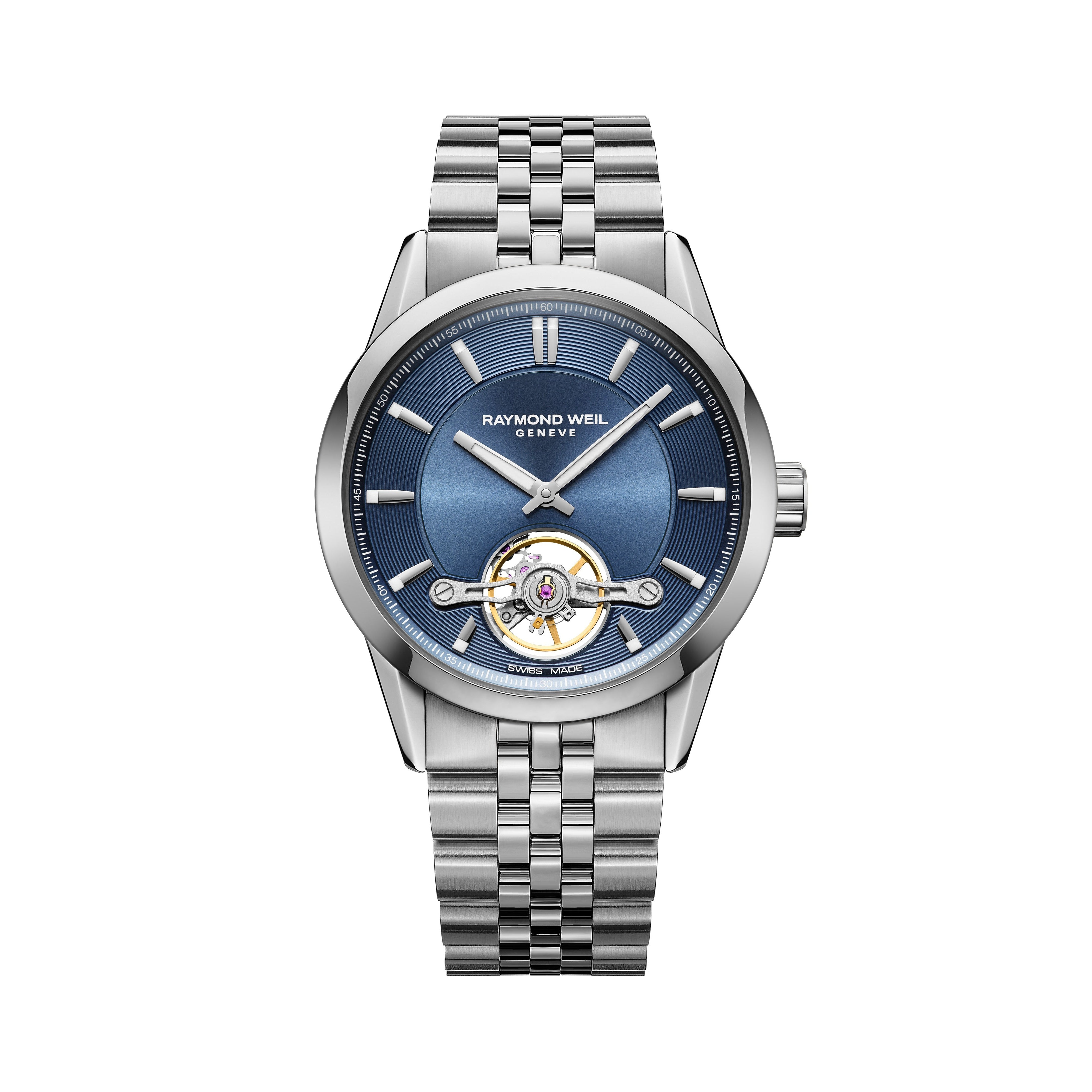
Raymond Weil's story is the in-house Calibre RW1212, its first movement made in-house, which you'll find in the Freelancer Calibre RW1212. The dial is open-worked to show the balance at six o'clock, held by a single bridge. Elsewhere in the range, the A.R.T. Automatic runs on a self-winding movement with a 41-hour power reserve. Only Raymond Weil pairs an in-house calibre with independent family ownership, and for some buyers that's the whole point.
Freelancer Calibre RW1212 2781-ST-50051
The in-house calibre

A blue open-worked dial puts the RW1212's balance on show at six o'clock, and the rotor carries Côtes de Genève striping and the Raymond Weil name. Hours and minutes only: the movement is the complication.
Who it suits: The buyer who wants an in-house Swiss movement, not a group calibre.
RRP $4,895 AUD
View the Freelancer RW1212 →Design Language
Tissot plays the hits, Longines plays the classics, and Raymond Weil plays its own tune. Tissot's PRX revives a Tissot case shape from 1978. Longines builds on nearly two centuries of history and a reputation for elegance, with collections such as the Master Collection.
Raymond Weil's designs are more personal. The Millesime Jubilee, limited to 500 pieces for the brand's 50th anniversary, is a vintage-style automatic chronograph. The A.R.T. Automatic Blue is the brand's first integrated-bracelet watch, all H-shaped links and polished bevels. And the Freelancer brings a modern, urban edge to the men's automatic.
Millesime Jubilee 7776-STC-65501
Vintage design, limited to 500

Made for Raymond Weil's 50th anniversary and limited to 500 pieces, the Jubilee is an automatic bi-compax chronograph. A light blue dial carries two dark blue counters, small seconds at nine o'clock and a 30-minute counter at three, under a glass-box sapphire crystal. The RW5030 movement holds a 62-hour power reserve and shows through a sapphire caseback.
Who it suits: Anyone who loves vintage design and wants something rarer than a classic three-hander.
RRP $6,995 AUD
View the Millesime Jubilee →A.R.T. Automatic Blue 1000-ST-50001
The integrated bracelet

A 38mm self-winding A.R.T. with a 41-hour power reserve, a sunray blue centre and an azuré minute track, a fluted crown that echoes the bezel, and 100 metres of water resistance. The solid caseback can be engraved.
Who it suits: Buyers drawn to the integrated-bracelet look who want something less expected.
RRP $3,300 AUD
View the A.R.T. Blue →Where Frederique Constant Fits
Frederique Constant is a natural comparison for Raymond Weil. Aletta and Peter Stas started designing their own watches in 1988, and moved the business to Geneva in 1997. In 2004 the brand launched its first manufacture calibre, the FC-910, developed and assembled in-house, with its signature Heart Beat opening at six o'clock. Two years later it opened its manufacture in Plan-les-Ouates. In 2016 the founders accepted an acquisition offer from Citizen, so unlike Raymond Weil, it's no longer family-owned.
Where it differs from Raymond Weil is in the movements. Frederique Constant has a dedicated Manufacture line built around its own calibres, such as the Manufacture Classic Date, while Raymond Weil's in-house RW1212 appears in the Freelancer. Where Raymond Weil differs is design: the Millesime Jubilee's vintage chronograph dial and the A.R.T.'s sculpted bracelet are more adventurous than Frederique Constant's classic lines. Both are Geneva brands, and both sit in the same price bracket.
Frederique Constant Manufacture Classic Date FC-706S3H6
A manufacture calibre in a classic case

The FC-706 manufacture calibre gives a 72-hour power reserve, inside a 40mm steel case with a sunray silver dial, a pointer date at six and a blue alligator strap.
Who it suits: Anyone who wants an in-house movement in a traditional dress watch.
Our price $5,609 AUD
View the Classic Date →Frederique Constant Highlife Automatic COSC FC-303G3NH6B
The certified sports watch

A 39mm steel Highlife with an integrated bracelet and no lugs, so it sits naturally on the wrist. The British racing green dial is sunray-finished with an embossed globe pattern, the automatic movement is COSC certified, and it's water resistant to 100 metres.
Who it suits: Buyers weighing the A.R.T. who want a chronometer-certified movement.
Our price $3,395 AUD
View the Highlife COSC →The Price Ladder in Australia
The four brands sit on different rungs, with some overlap. A 40mm steel Tissot PRX Powermatic 80 lists at $1,220. A 39mm steel Longines Master Collection automatic lists at $3,925. At Watch Direct, the Frederique Constant Highlife Automatic COSC is $3,395. Our Raymond Weil range runs from $1,995 for a quartz Toccata to $6,995 for a limited-edition Millesime chronograph, with steel automatics from $3,300. The A.R.T. Automatic is $3,300 RRP and the in-house Freelancer Calibre RW1212 is $4,895.
So Tissot is clearly the cheapest way into a Swiss automatic. Raymond Weil, Frederique Constant and Longines overlap for a steel automatic, and there the choice comes down to design and what you value in the brand behind it.
A.R.T. Automatic Sage Grey 1000-ST-52001
Our everyday pick

A 38mm steel automatic with a sage grey dial, a date at three and a 41-hour power reserve. The sapphire crystal has anti-reflective and anti-fingerprint coatings, and it's water resistant to 100 metres.
Who it suits: Anyone weighing a Longines automatic who wants something with more personality for similar money.
RRP $3,300 AUD
View the A.R.T. Sage Grey →Raymond Weil vs Longines vs Tissot: Side by Side
| Raymond Weil | Longines | Tissot | Frederique Constant | |
|---|---|---|---|---|
| Founded | 1976, Geneva | 1832, Saint-Imier | 1853, Le Locle | 1988, Geneva |
| Ownership | Independent, family-run | Swatch Group | Swatch Group | Citizen (since 2016) |
| Movement story | In-house Calibre RW1212 | Silicon balance spring in all automatics | Powermatic 80, up to 80 hours | Own manufacture calibres since 2004 |
| Steel automatic, RRP | From $3,300 (our range) | $3,925 (Master Collection 39mm) | $1,220 (PRX 40mm) | $3,395 (Highlife COSC 39mm, our price) |
| Best for | Distinctive design, independence | Heritage and classic elegance | Maximum value | In-house movements, Geneva |
Which Should You Buy?
Choose Tissot if your budget is under about $1,500 and you want a well-made Swiss automatic with a long power reserve. Choose Longines if heritage is what you're buying and you prefer traditional elegance. Choose Frederique Constant if you want a Geneva watch with a manufacture movement, or a COSC-certified integrated-bracelet sports watch. Choose Raymond Weil if you want a watch with its own personality, distinctive dial work, and the knowledge that a family business, not a group, stands behind it.
Our view? Between $3,000 and $5,000, Raymond Weil is the more interesting watch. The Millesime and the RW1212 each offer something genuinely different at the money. Looking more widely? Our guide to Swiss watch brands covers the field.
See every Raymond Weil watch at Watch Direct
Shop Raymond Weil →Frequently Asked Questions
Is Raymond Weil better than Longines?
Neither is simply better. Longines has the longer history and the backing of a large group; Raymond Weil is an independent family house with more adventurous design and an in-house calibre in the Freelancer. At similar money, choose on which design you'd rather wear.
Is Raymond Weil better than Tissot?
They do different jobs. Tissot is the most affordable route to a Swiss automatic of the three. Raymond Weil costs more and gives you more distinctive design and a family-run independent house behind the watch.
Is Raymond Weil better than Frederique Constant?
They're close neighbours. Both are Geneva brands with in-house movements in their ranges. Frederique Constant has been owned by Citizen since 2016 and has a dedicated Manufacture line of in-house calibres; Raymond Weil is still independent and family-run, with more unusual design. Choose on the watch you prefer.
Who owns Longines, Tissot and Frederique Constant?
Longines and Tissot are members of the Swatch Group, and Frederique Constant has belonged to Citizen since 2016. Raymond Weil is the only one of the four that's independent and still run by the family that founded it in 1976.
Does Watch Direct sell Longines or Tissot?
No. We don't sell Longines or Tissot, so those parts of this comparison are editorial. We sell Raymond Weil and Frederique Constant, and both ship free across Australia with the full manufacturer's warranty.
Which is the oldest brand?
Longines, founded in Saint-Imier in 1832. Tissot followed in Le Locle in 1853, Raymond Weil was founded in Geneva in 1976, and Frederique Constant began in 1988.
Our Pick
Raymond Weil: the independent choice
Swiss made, family-run since 1976, and designed with real character. Every Raymond Weil we sell ships free across Australia with the full manufacturer's warranty.
Shop Raymond Weil →