


Best Automatic Watches Australia 2026 — From First Timer to Collector
Best Automatic Watches Australia 2026 — From First Timer to Collector
Buying Guide · 2026

From $450 entry-level pieces to collector-tier complications — the best automatic watches you can buy in Australia right now.
At a Glance
The best automatic watches in Australia across every budget — entry-level pieces worth owning to collector-tier complications worth saving for.
- Best Entry-Level: Timex E-Line 1983 Reissue — genuine automatic character at an honest price
- Best Entry-Level Diver: Citizen Promaster Marine NY0085-19E — 200m automatic diver under $700
- Best Under $700: Citizen Tsuyosa NJ0150-81A — clean, reliable, exhibition caseback
- Best Mid-Range: Seiko Prospex Alpinist SPB121J — the automatic everyone recommends first
- Best for Complications: MAEN Brooklyn 36 Triple Calendar — day, date, and month in 36mm
- Best Premium: Victorinox I.N.O.X Automatic — Swiss automatic built to take actual punishment
- Best Collector Piece: Ball Trainmaster Moon Phase — tritium gas tubes, moon phase, impeccable finishing
In This Guide
- What Is an Automatic Watch?
- Timex E-Line 1983 Reissue — Entry Level
- Bulova Classic Surveyor — Entry Level
- Citizen Promaster Marine NY0085-19E — Entry Level
- Citizen Tsuyosa NJ0150-81A — Entry Level
- Seiko Presage Cosmopolitan — Mid-Range
- Seiko Prospex Alpinist SPB121J — Mid-Range
- MAEN Brooklyn 36 Triple Calendar — Mid-Range
- Victorinox Airboss Mechanical — Premium
- Victorinox I.N.O.X Automatic — Premium
- Accutron Astronaut GMT — Collector
- Ball Trainmaster Moon Phase — Collector
- Frequently Asked Questions
Hold an automatic watch to your ear and listen. There's a sound — a faint, rapid ticking that isn't really ticking at all. It's the rotor spinning, the escapement engaging, 200 or 300 or 400 times per hour depending on the calibre. It's a machine measuring time, powered only by the motion of your wrist. No battery, no charging, no subscription. Just physics.
That's the thing about automatic watches that gets people. Once you understand what's happening inside — the balance wheel oscillating, the gear train advancing, the hands moving forward one tiny step at a time — you can't un-see it. Every glance at the dial is a reminder that there's something genuinely mechanical happening under the crystal. This guide covers the best automatic watches available in Australia right now, across every budget from $450 to $3,950.
What Is an Automatic Watch?
An automatic watch is a mechanical watch — powered by a mainspring — that winds itself using a rotor attached to the movement. As your wrist moves throughout the day, the rotor spins and transfers energy to the mainspring, keeping the watch running without manual winding. When you take it off, the stored energy continues running the watch for a period called the power reserve, typically 38 to 80 hours depending on the calibre.
Automatic watches are not more accurate than quartz — a typical automatic movement runs within ±10–20 seconds per day, while a quartz watch is accurate to within a second per month. But accuracy isn't why people wear them. They wear them because the engineering involved is genuinely remarkable — hundreds of components, most smaller than a grain of rice, working together to do something a $2 chip does more reliably. The point is the craft, not the precision.
Timex E-Line 1983 Reissue TW2W70800 — Entry Level
Timex made watches in the United States for most of the 20th century. The E-Line 1983 Reissue reaches back to that era — specifically to Timex's early 1980s automatic range, when the brand was producing genuinely considered mechanical watches before quartz swept the category. The reissue is faithful to the original proportions: 40mm, brushed steel case, simple dial with a date window at 3 o'clock.

The Timex E-Line 1983 Reissue TW2W70800 at $449.95 is one of the better entry points into automatic watches available in Australia. It's not trying to be a tool watch or a dress watch — it's just a clean, honest automatic with a stainless bracelet and a movement you can feel engaging when you put it on. For a first automatic, this is a watch that won't feel like a compromise.
Bulova Classic Surveyor 96B435 — Entry Level
Bulova's Classic line sits at the intersection of dress watch aesthetics and affordable automatic horology. The Surveyor is a three-hand automatic in a traditional format — slim case, clean dial, leather strap — but the movement underneath is the story. Bulova has been developing their own movements in-house since the 1950s, and the calibre in the Surveyor reflects that heritage: reliable, well-finished, and genuinely Bulova.

The Bulova Classic Surveyor 96B435 at $575 is the automatic dress watch you buy when you want something you can wear to a job interview and a dinner on the same day. Black dial, slim profile, tan leather strap. There's nothing flashy here — just a well-proportioned automatic that wears correctly under a shirt cuff. If you're building a wardrobe of watches rather than collecting for its own sake, this is the gap it fills.
Citizen Promaster Marine NY0085-19E — Entry Level
The Promaster Marine is Citizen's workhorse automatic diver. It runs the NH35 movement — a Miyota-based calibre that Citizen specifies for their sport automatics — in a 200m water-resistant case with a unidirectional bezel, screw-down crown, and lume applied to every marker and hand. This is an automatic watch built for actual use in water, not just the occasional splash.

The Citizen Promaster Marine NY0085-19E at $625 is the automatic diver for people who actually go in the water. 44mm case, 200m water resistance, proper ISO 6425 dive watch certification. The lume is strong. The bezel clicks with authority. It's a capable tool watch — not the most elegant piece in this guide but genuinely fit for purpose. If you want an automatic diver under $700 that won't let you down underwater, this is it.
Citizen Tsuyosa NJ0150-81A — Entry Level
The Tsuyosa — meaning "strength" in Japanese — is Citizen's accessible automatic sport watch. It's not a diver and it doesn't pretend to be. What it is: a 40mm stainless steel case, a white dial with applied indices, a screw-down caseback with an exhibition window showing the movement, and Citizen's reliable in-house automatic calibre. At 100m water resistance it handles daily life without drama.

The Citizen Tsuyosa NJ0150-81A at $650 is the automatic for someone who wants to see the movement. The exhibition caseback lets you watch the rotor spin every time you flip the watch over — it's a small thing but it never gets old when you're new to mechanical watches. Clean, versatile, and backed by Citizen's manufacturing standards. Hard to fault at this price.
"An automatic watch is powered entirely by your own movement. When you take it off, it keeps running on stored energy. It's been doing this without batteries since before your grandparents were born."
Seiko Presage Cosmopolitan SRP839J — Mid-Range
The Presage Cosmopolitan is Seiko's dress automatic — inspired by the cocktail watches of the 1960s, with dials that use enamel and lacquer techniques developed in Seiko's Shizukuishi Watch Studio. The SRP839J is a ladies' piece but at 30.4mm it wears beautifully on smaller wrists of any gender, and the mother-of-pearl dial is one of the most genuinely elegant dials in the Seiko range.
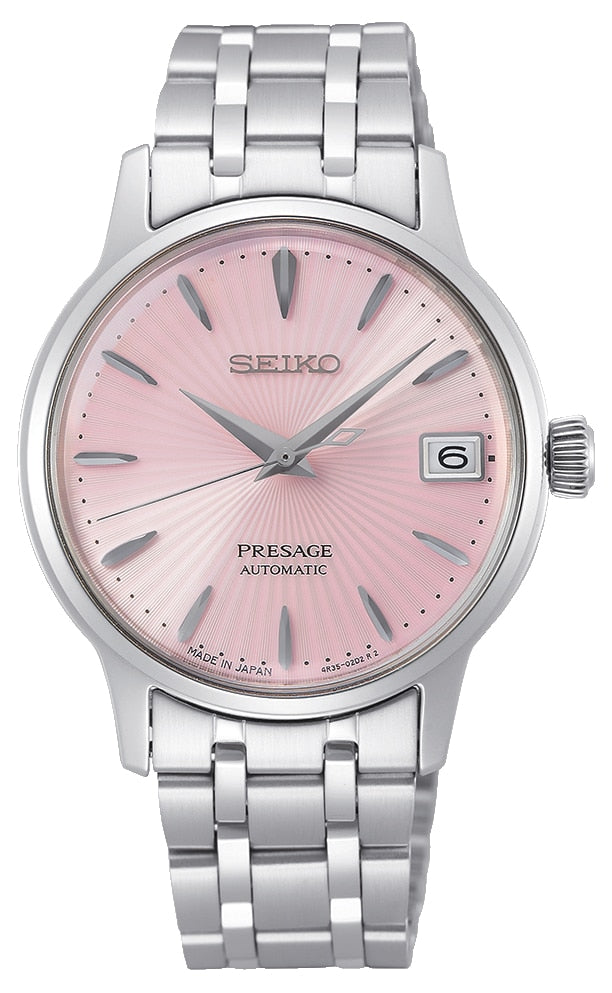
The Seiko Presage Cosmopolitan SRP839J at $696 runs the 4R35 automatic calibre with hacking and hand-winding. The Presage line represents Seiko at their craft-conscious best — these aren't just watches, they're pieces where the dial itself is a demonstration of skill. For someone who wants an automatic dress watch without the Swiss markup, the Presage Cosmopolitan delivers more character per dollar than almost anything in this price range.
Seiko Prospex Alpinist SPB121J — Mid-Range
Some watches are just correct. The Alpinist is one of them. Originally designed for Japanese mountain climbers in 1959, the Alpinist has evolved without losing its identity — a tool watch that wears beautifully because the requirements of the mountains and the requirements of good design turned out to be the same thing. Every generation has made it better without making it worse.
The Seiko Prospex Alpinist SPB121J runs the 6R35 automatic — a 70-hour power reserve, hacking, hand-winding, and Seiko's proven reliability. The inner compass bezel is functional. The 39.5mm case wears slim on the wrist. The green dial shifts in light in a way that cheaper dials don't. At $1,200, this is the automatic that watch communities recommend most often as the first serious piece — and they're right to recommend it.
MAEN Brooklyn 36 Triple Calendar M5.1.1 — Mid-Range
MAEN is a microbrand founded in Stockholm that makes small-run mechanical watches with complications that most brands at this price point don't attempt. The Brooklyn 36 Triple Calendar displays day, date, and month — a genuine triple calendar complication in a 36mm case. That's meaningful. Triple calendars are typically found on watches that cost multiples of what MAEN charges.

The MAEN Brooklyn 36 Triple Calendar M5.1.1 at $1,275 is for the buyer who wants to wear something genuinely interesting on their wrist. Three windows across the dial — day, date, month — all driven by a Swiss automatic movement in a 36mm case that wears with the kind of discretion that larger watches can't manage. It's for the person who follows Hodinkee, knows why a triple calendar matters, and wants one at a price that doesn't require a savings plan.
Victorinox Airboss Mechanical 241888 — Premium
Victorinox built their reputation on the Swiss Army Knife — a tool designed to perform under pressure and last decades without complaint. The Airboss Mechanical applies the same philosophy to watchmaking. It's a pilot's watch: large crown, antimagnetic properties, clean legible dial, Swiss mechanical movement. The name comes from the aircraft carrier flight deck officer who coordinates air operations — a role where legibility and reliability are non-negotiable.

The Victorinox Airboss Mechanical 241888 at $2,295 is a Swiss automatic with pilot's watch proportions — 44mm case, bold indices, generous lume, exhibition caseback. The movement is Swiss made and visible through the caseback. At this price you're buying into genuine Swiss mechanical watchmaking without the inflated brand premium that other Swiss names carry. It's for someone who wants a proper automatic pilot's watch and doesn't need a famous logo to feel the value.
Victorinox I.N.O.X Automatic 242019 — Premium
The I.N.O.X is Victorinox's most tested watch. Every case goes through 130 separate durability tests — military shock, deep freezing, magnetic resistance, mud immersion, submersion, sand, pressure — before it ships. This isn't marketing copy. Victorinox published the testing protocols. The I.N.O.X Automatic brings a self-winding movement into a case architecture that was designed to outlast everything you can put it through.

The Victorinox I.N.O.X Automatic 242019 at $2,795 is the automatic for people who actually need a watch to survive. 41mm case, 200m water resistance, Swiss automatic movement, stainless bracelet. The black dial is clean and immediately legible. This is the watch you strap on before a field expedition, a diving trip, or a construction site, and you stop thinking about it. Nothing in this guide is more purely a tool.
"The I.N.O.X goes through 130 durability tests before it ships. Victorinox published the protocols. It's one of the few watch claims you can actually verify."
Accutron Astronaut GMT 26B205 — Collector
Accutron has genuine space heritage. The brand's tuning fork technology — developed in the 1960s — was used in NASA satellites and became synonymous with precision timekeeping at the height of the space race. The modern Astronaut GMT is a contemporary expression of that history: a GMT complication with dual time zone tracking, in a design language that references the original Accutron Astronaut watches that NASA engineers actually wore.

The Accutron Astronaut GMT 26B205 at $3,399 is for the buyer who wants a watch with a real story behind the design — not a manufactured heritage narrative, but actual aerospace history embedded in the dial. The GMT complication is practical; the story behind it is extraordinary. There aren't many watches at this price that carry the kind of provenance the Accutron name represents. Browse the full GMT watches collection at Watch Direct for more dual time zone options.
Ball Trainmaster Moon Phase NM3082D-SJ-SL — Collector
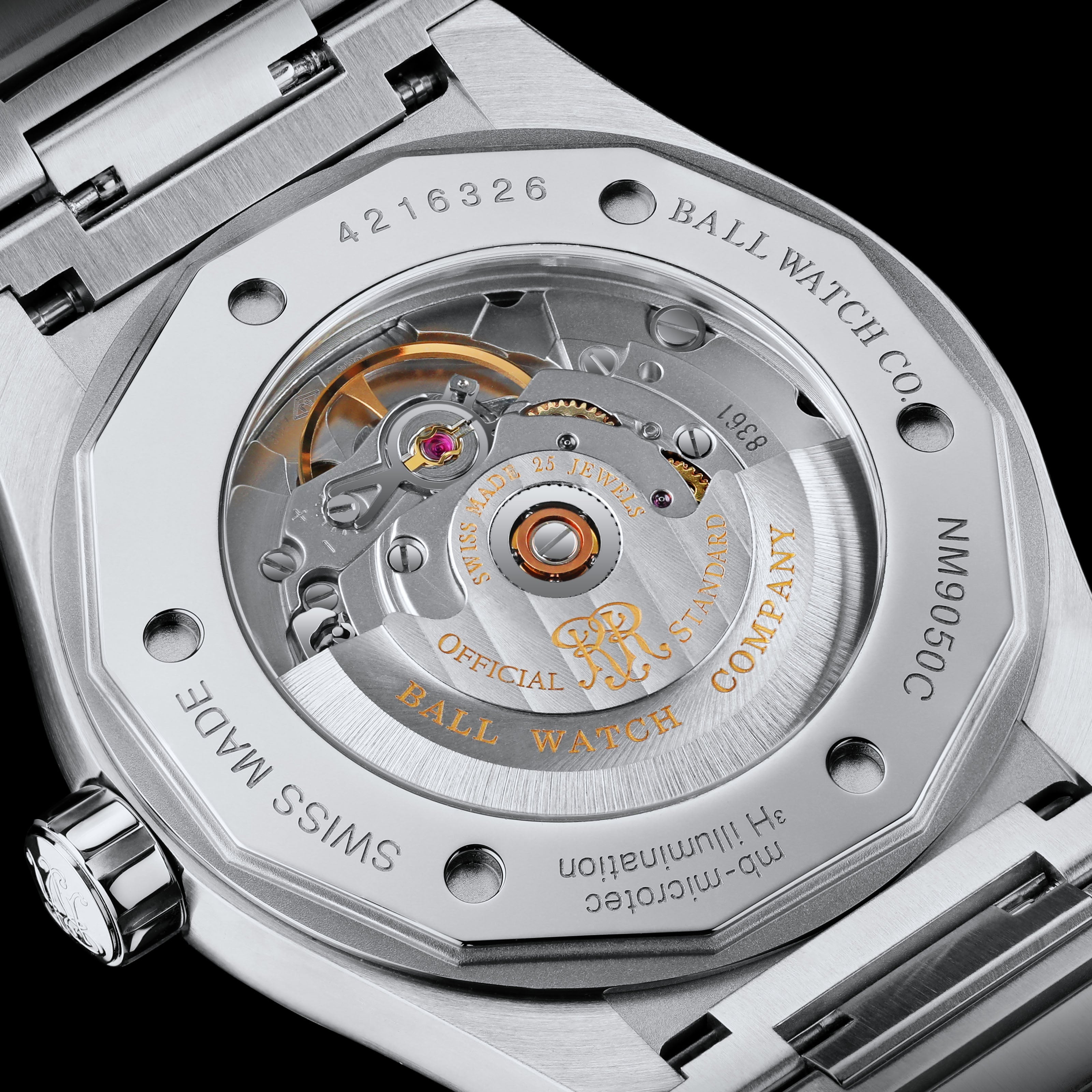
Ball Watch Company was founded in 1891 to supply railways with precision timepieces after a series of accidents attributed to inaccurate watches. Their current signature feature — micro gas tubes filled with tritium — maintains that obsession with legibility. The tritium tubes glow for 25 years without any power source, providing constant illumination that doesn't require charging or button-pressing. The Trainmaster Moon Phase adds a lunar complication to this engineering foundation.

The Ball Trainmaster Moon Phase NM3082D-SJ-SL at $3,950 is the most technically interesting watch in this guide. The tritium gas tube lume is permanent and requires nothing from you — it just glows, always, for decades. The moon phase complication is accurate to within one day every 128 years. The day-date display is crisp. The dial is busy in a satisfying way — every element earns its presence. For a collector adding a complication piece, this is the one.
Authorised Retailer
Why Buy Your Automatic Watch from Watch Direct?
Watch Direct is an authorised retailer for every brand in this guide — Timex, Bulova, Citizen, Seiko, MAEN, Victorinox, Accutron, and Ball. Every automatic watch comes with a full Australian manufacturer's warranty and is sourced through official distribution channels. We've been selling watches in Australia since 2011 and our team wears automatics daily.
Free shipping Australia-wide · Same-day dispatch on in-stock items · Afterpay available
Browse Automatic Watches →Frequently Asked Questions
How does an automatic watch work?
An automatic watch uses a mechanical movement powered by a mainspring — a coiled metal spring that stores energy. As you wear the watch, a weighted rotor spins with your wrist movement and winds the mainspring automatically. The stored energy releases gradually through a gear train, driving an escapement that regulates the hands. When you stop wearing it, the mainspring unwinds over a period called the power reserve — typically 38 to 72 hours. After that, the watch stops and needs either wrist movement or manual winding to restart.
Do automatic watches need servicing?
Yes. Automatic movements are mechanical machines with moving parts that need lubrication. Most manufacturers recommend a service every 5–10 years depending on usage and the specific calibre. A service involves disassembling the movement, cleaning all components, replacing worn parts, re-lubricating, reassembling, and regulating for accuracy. A typical service for a mid-range automatic costs $200–$500 in Australia depending on the calibre and service centre. This is the ongoing cost of mechanical watch ownership — factor it in when you're budgeting.
Are automatic watches accurate?
Most automatic movements run within ±10–20 seconds per day. High-spec calibres like the Seiko 6R35 or Citizen's better movements are rated to ±15 seconds per day. Some premium movements achieve ±5 seconds per day or better. For comparison, a standard quartz watch is accurate to within 15 seconds per month. Automatic watches are not bought for precision — they're bought for the engineering, the heritage, and the experience of wearing a mechanical object. If you need a second-by-second accurate timepiece, use your phone.
What is the difference between automatic and manual (hand-wind) watches?
Both are mechanical watches — the difference is how the mainspring gets wound. An automatic winds itself using a rotor that spins with wrist movement. A manual-wind watch requires you to wind it by rotating the crown, typically once daily. Most modern mechanical watches are automatic. Manual-wind watches tend to be thinner because they don't need a rotor, and some collectors prefer the ritual of daily winding. All watches in this guide are automatic unless otherwise specified.
Can you overwind an automatic watch?
No. Automatic watches have a slip-clutch mechanism that prevents overwinding — the mainspring stops accepting energy once it's fully wound. You can safely wind an automatic by hand through the crown without risk of damage. In practice, a fully wound automatic worn daily will maintain its power reserve without ever running down.
What is a power reserve on an automatic watch?
Power reserve is the duration the watch will run after being fully wound — the amount of stored energy in the mainspring. Most automatic movements have a power reserve of 38–48 hours. Better calibres (like the Seiko 6R35 in the Alpinist) offer 70 hours. The Ball Trainmaster Moon Phase offers 40 hours. A longer power reserve means you can take the watch off Friday night and put it back on Monday morning without it stopping over the weekend.
Is an automatic watch worth more than a quartz watch?
From a manufacturing standpoint, yes — the engineering involved in an automatic movement is significantly more complex than a quartz module. A quality automatic movement can contain 100–300 components; a quartz movement has fewer than a dozen. Whether an automatic is worth more to you depends on what you value. If you want accuracy and low maintenance, quartz is rational. If you want a watch with engineering heritage, a rotor you can hear spinning, and a movement worth looking at through a caseback, an automatic is worth the premium.